Some Senatorial Tears for the Ink-Stained Wretches
vs.
Why David Simon Is Wrong About Blogs and Local Reporting
Monday, May 11, 2009

Monday, April 13, 2009
Final Story Idea
As already-poor college students looking at potential fee increases, I feel much of our discussion around UMass' economic situation has focused on the direct consequences for the students. In my article, I plan to answer the question: How is the recession affecting job stability for faculty at UMass Amherst?
In this Daily Collegian article from early March, it's stated that 91 professors are looking at potential non-reappointment for next year. The author also quotes an email from February in which Chancellor Holub discussed the possibility of vacating 50 faculty positions, 30 lecturers and 150 teaching assistants.
I plan on looking into these statistics and getting updated numbers on who will/may not return next year. Who exactly is getting cut? I'd also like to get specific names, and speak with teachers who have received notices of non-reappointment. It would be helpful to talk to at least one person from each group - full time, part time, and teaching assistants. Are these people worried about finding work elsewhere? Do they think it fair that the University is cutting them off during a recession?
Furthermore, I'd like to talk with someone at an administrative level who can explain the reasons for cutting teachers. Ed Blaguszewski, the university spokesperson, may be able to answer my questions.
For the "Voices" compomnent, I plan on using my most interesting interview with a cut teacher. How long have they been teaching/at UMass? What's the faculty opinion on UMass' handling of the economic situation? What are their plans after leaving UMass?
In this Daily Collegian article from early March, it's stated that 91 professors are looking at potential non-reappointment for next year. The author also quotes an email from February in which Chancellor Holub discussed the possibility of vacating 50 faculty positions, 30 lecturers and 150 teaching assistants.
I plan on looking into these statistics and getting updated numbers on who will/may not return next year. Who exactly is getting cut? I'd also like to get specific names, and speak with teachers who have received notices of non-reappointment. It would be helpful to talk to at least one person from each group - full time, part time, and teaching assistants. Are these people worried about finding work elsewhere? Do they think it fair that the University is cutting them off during a recession?
Furthermore, I'd like to talk with someone at an administrative level who can explain the reasons for cutting teachers. Ed Blaguszewski, the university spokesperson, may be able to answer my questions.
For the "Voices" compomnent, I plan on using my most interesting interview with a cut teacher. How long have they been teaching/at UMass? What's the faculty opinion on UMass' handling of the economic situation? What are their plans after leaving UMass?
Monday, March 23, 2009
Flywheel

Of the $787 billion worth of aid in the latest stimulus package, only $50 million is being put towards the National Endowment for the Arts. This seems a particularly small piece of the pie for an industry that generates roughly $166 billion each year. However, this disconnect between funding and the arts’ economic importance hasn’t discouraged local arts collective Flywheel. The group is on track to celebrate its grand reopening slated for late spring or early summer.
Started in 1999, Flywheel operated a café and arts space located at 2 Holyoke Street in Easthampton. It quickly became a bastion of the arts in Western Massachusetts, providing a reliable performance space for both local and touring musicians. “While music is the focus, it’s not the exclusive thing,” says Jeremy Smith, a member of the organization. “The programming that happens really reflects whoever’s involved at any one time.” Visual arts, theatre, and other creative endeavors have all found homes at Flywheel.

Flywheel's new location at 43 Main Street, Easthampton.
The space has hosted many memorable concerts over the years. Speaking with Ken Maiuri, a writer for the Daily Hampshire Gazette and DJ at WMUA, he recalled one of his favorite shows. In 2000, the space hosted Harvey Sid Fisher, a cult musician who writes songs about astrology signs. “I didn’t think I’d ever be able to see him live, but for some reason, he played at Flywheel,” says Maiuri.
Over the years, Flywheel’s members began to realize the limitations of the small space. Smith brought up the example of Ted Leo, a now-popular indie rocker who played at Flywheel early in his career. Leo, who played a benefit show for the organization in October 2007 in Northampton, would have drawn too large an audience for the Holyoke St location.
 Upstairs at the new Flywheel.
Then, in early 2007, Will Bundy, owner of East Works in Easthampton, submitted a proposal to turn the Easthampton Old Town Hall into an arts building. Bundy, who already found a framing shop and a gallery to rent space there, wanted a performance component for the building. Flywheel took up the offer, agreeing to rent the second story main hall and smaller first floor room. They closed the doors at Holyoke St. that spring and began the process of moving. “At first we thought it would be a six to eight month closing,” said Smith with a laugh. The new space is still waiting to open, pending completion of renovations.
In addition to the “wheels of bureaucracy grinding slowly,” says Smith, sprinklers are currently being installed, construction permits are waiting to be okayed, and the space’s paint was recently found to contain lead. The abatement of the lead paint put the group back roughly $10,000. “If we didn’t have to pay that, we probably would have enough money to do the whole thing,” says Smith, referencing the $20,000 - $40,000 needed to complete the rest of the renovations. However, the money is nearly all raised, and Smith hopes to see the space open by early summer.
Flywheel’s fundraising is now nearly all based on individual donations. When the space was open they earned money from the café and from shows, usually taking somewhere around 15 percent of the ticket price and distributing the rest to the musicians. With the space closed, however, those funds haven’t been available, which is one major incentive for opening as soon as possible.

Downstairs at the new Flywheel.
While the organization hasn’t felt direct effects of the recession yet, there have been some repercussions. The Massachusetts Cultural Council had an open-ended arts grant for which Flywheel planned to apply. However, that grant has now been cancelled, closing a potential source of revenue for Flywheel (and other not-for-profits).
The city of Easthampton, while not funding anything directly, is taking a hand in aid by covering electrical and heat bills for the first few years of the new space’s operation.
During the recession, Smith believes that Flywheel could be beneficial in providing revenue for working artists as well as providing relatively cheap entertainment. “We’re supporting artists and giving them a venue to make money. It’s an affordable entertainment option for people, and I know with limited amounts of disposable cash it’s an option for people. And also we’re supporting artists, so artists have a venue to perform their work, they can make some money, they can get their word out, so that definitely has an impact.”
Flywheel reopens later this spring or early this summer.
Listen to Ken Maiuri discuss his experiences with Flywheel. Music by Northampton musician Eric Hnatow.
Sunday, March 8, 2009
Art, Attribution, and Shepard Fairey
 In early February, the Associated Press accused artist Shepard Fairey of copyright infringement in failing to credit photographer Mannie Garcia for the image on which the now iconic Obama portrait was based.
Before the A.P. could sue Fairey, however, the artist beat them to the punch with a lawsuit of his own.
Fairey's lawyers stated that he shouldn't be forced to receive "misguided threats from The A.P." In an interview with NPR's Terry Gross, Fairey seems to imply that the A.P.'s allegations were harmful to his reputation as an artist. This would appear to be the main motive behind the preemptive legal action.
Garcia, in an interview of his own with Gross, cares most about Fairey's lifting the photograph off the web. "Simply because it's on the internet doesn't mean it's free for the taking." In the New York Times, Garcia again brings up the issue of the web. “I don’t condone people taking things, just because they can, off the internet.”
The real issue at hand, behind the damaged egos and internet anger, seems to be one for the art majors to debate: How much does an image need to be changed for it to exist as a work of art in its own right, not merely as an altered version of an existing image?
Famous art of the past jumps to mind. Take Warhol's Campbell's Soup Cans. Should the credit for these paintings go to Warhol or the original designer of the labels? After all, there would be no Warhol painting without the original label layout.
Or take Marcel Duchamp's L.H.O.O.Q., a postcard of the Mona Lisa with a mustache drawn on and those mysterious letters written underneath. Duchamp didn't much alter the original painting, and certainly less than Fairey did Garcia's photograph. So, was it Duchamp's right to call the product his own work?
It becomes tricky terrain when the worlds of attribution and art start to mix. Nearly all art is based on some sort of preexisting image. What if everyone who's been portrayed in a painting files suit against the painters? What if the manufacturers of the myriad products appearing in photographs on Flickr sue the photographers? Follow this path and eventually there exists no art.

What does seem fair is that Fairey should pay the applicable licensing fees for using A.P. media, just as any major organization would. Beyond that, no damage claims should be filed on either side. Fairey's use of the image doesn't hurt the Associated Press, and they haven't done anything to seriously damage Fairey's reputation. The portrait in fact ups the profile of both parties involved.
Perhaps, too, Garcia should be happy (after receiving the usual compensation from the A.P.) that one of his photographs played such a major role at an important time in history.
Oh, wait, he already is.
“If you put all the legal stuff away, I’m so proud of the photograph and that Fairey did what he did artistically with it, and the effect it’s had.”
So... why are we still arguing?
Sunday, February 22, 2009
Story Ideas
Story 1
For my stimulus story, I'll be looking at the money UMass may receive in relation to the recently announced student fees increase.
On Friday, the UMass Board of Trustees backed an increase of student fees that would add $1500 to yearly in-state tuition. Currently, tuition is $10,232 per year, and this would raise that total to over $11,500.
This increase still must be approved by the full board, which will vote on Friday, February 27.
According to the Boston Globe, the school might receive $3.3 million to go towards "federal financial aid to low-income UMass students." If this goes through, the proposed increase may be altered or canceled. UMass president Jack M. Wilson says:
I'll talk to:
Story 2
For story 2, I'll take a look at Flywheel, the arts collective based in Easthampton. Flywheel has been on hiatus for a number of years and, after many false starts, is finally gearing up to reopen.
After reading this article in the New York Times about the survival of the arts when the nation is faced with a serious recession, I'd like to examine how a non-profit organization is coping with these difficult economic times. Flywheel gets support mainly from individuals, as explained in their FAQ:
I'll talk to:
Story 3
I recently read an article on the increasing difficulties in finding a job experienced by recent college grads with degrees in journalism. I am 90% positive that I read it on the New York Times website, but I've spent nearly an hour searching and I cannot find the story. I know the story's out there, though, and as soon as I find it, I'll edit this post and provide a link to it.
In any case, I'll localize this story by turning the microscope on my fellow UMass journalism students, both current and recently graduated. What do those soon finishing school think about the current job market? What troubles have recent graduates found in searching for jobs? What are the faculty's thoughts on the state of the journalism job market? Is journalism really a dying industry, as some think? Is it a good time to be getting a journalism degree?
I'll talk to:
For my stimulus story, I'll be looking at the money UMass may receive in relation to the recently announced student fees increase.
On Friday, the UMass Board of Trustees backed an increase of student fees that would add $1500 to yearly in-state tuition. Currently, tuition is $10,232 per year, and this would raise that total to over $11,500.
This increase still must be approved by the full board, which will vote on Friday, February 27.
According to the Boston Globe, the school might receive $3.3 million to go towards "federal financial aid to low-income UMass students." If this goes through, the proposed increase may be altered or canceled. UMass president Jack M. Wilson says:
This increase is designed to preserve academic quality and to ensure stability, but if federal dollars can be substituted for student dollars, we will eagerly rebate some or all of this increase.At a time when many families are feeling economically strapped, why is UMass raising tuition? Is this a fair move to students? Can a UMass student currently relying on financial aid afford this proposed increase?
I'll talk to:
- Robert J Manning, the Chairman of the UMass Board of Trustees
- Tim Scott, Servicing Representative of the GEO, the UMass Graduate Union
- Corey Gates, UMass undergraduate who relies on financial aid and works two jobs to pay for school
Story 2
For story 2, I'll take a look at Flywheel, the arts collective based in Easthampton. Flywheel has been on hiatus for a number of years and, after many false starts, is finally gearing up to reopen.
After reading this article in the New York Times about the survival of the arts when the nation is faced with a serious recession, I'd like to examine how a non-profit organization is coping with these difficult economic times. Flywheel gets support mainly from individuals, as explained in their FAQ:
A portion of Flywheels funding comes from grants but we primarily rely on donations ranging from $1 to $1,000 from individuals. Fundraising events have included car washes, concerts, house shows, tag sales, an annual appeal, and record fairs. Many people and businesses have donated equipment, supplies and services. We also rely on sales from our café. The largest on-going contributions are the countless hours of volunteer work that keep Flywheel going. Your donations of time, money, goods, and services are greatly needed and appreciated!What kind of financial support has Flywheel been receiving lately? Are people still willing to volunteer their time and money? What does the town of Easthampton think about the survival of the arts collective? In times of economic struggle, do people still think the arts are important?
I'll talk to:
- Chris Cooper, "President" of Flywheel
- Members of the Easthampton city council - maybe President Daniel Rist or Vice-President Justin Cobb
- Thurston Moore, local arts champion and member of Sonic Youth
Story 3
I recently read an article on the increasing difficulties in finding a job experienced by recent college grads with degrees in journalism. I am 90% positive that I read it on the New York Times website, but I've spent nearly an hour searching and I cannot find the story. I know the story's out there, though, and as soon as I find it, I'll edit this post and provide a link to it.
In any case, I'll localize this story by turning the microscope on my fellow UMass journalism students, both current and recently graduated. What do those soon finishing school think about the current job market? What troubles have recent graduates found in searching for jobs? What are the faculty's thoughts on the state of the journalism job market? Is journalism really a dying industry, as some think? Is it a good time to be getting a journalism degree?
I'll talk to:
- Eric Athas, or any number of the other recent graduates listed here
- B.J. Roche, internship coordinator of the UMass journalism department
- Barbara McGlynn, journalism department adviser
Sunday, February 8, 2009
Follow-up: After the Grammys

Going into this year's Grammys, one had a feeling things might be a little different. It was the first ceremony in ages to be promoted through a large scale advertising campaign (and a pretty cool one at that), and the Recording Academy made some relatively hip nominations for major awards with artists like Lil Wayne, Radiohead, and M.I.A.
And, lo and behold, the high points did seem to come more often than usual. Still, there were few surprises hidden within the envelopes, and many performances felt forced and undercooked.
Take, for instance, the Jonas Brothers sharing the stage with Stevie Wonder. Without any insult meant to the Brothers, whose energy and audacity are commendable, maybe it wasn't the best idea to put three relatively inexperienced teenagers on stage with the most respected R&B singer on the planet. Especially when one of the them doesn't quite remember the words to Stevie's classic "Superstition," which they performed together.
And, in another head-scratcher, Paul McCartney played Beatles classic "I Saw Her Standing There" with Dave Grohl on drums, who was headbanging away like he was still on stage with Nirvana. To advertise a McCartney collaboration with nearly any modern-day rocker would already feel a little lopsided, but to hype up a performance with Grohl, and then to stick him on drums? A very odd pairing. Surely he could've at least strummed up an adequate rhythm guitar.
While these disorienting performances ran throughout the night (an off-key acoustic duet between Miley Cyrus and Taylor Swift, Katy Perry arriving in a giant banana which was surely the cheesiest entrance I've ever seen, etc.), there were many enjoyable moments, too.
Radiohead's performance with the USC Marching Band was an inspired burst of creative arrangement, despite three of the five band members mysteriously missing in action.
Justin Timberlake made no attempt at hiding his excitement to sing with Reverend Al Green, and the two seemed to bring out the best in each other.

A very pregnant M.I.A. triumphantly swaggered with the boys during T.I.'s "Swagger Like Us."
The highlight of the night, though, had to be Lil Wayne's "Tie My Hands." The rapper left his ego at the door in performing his ode to post-Katrina New Orleans, choosing to focus on his hometown instead of himself for the night. The song is powerful, mixing emotion and politics, presenting lines like "My whole city under water, some people still floatin'/then they wonder why black people still votin', cause your president's still chokin'." That then segued into Allan Toussaint and the Dirty Dozen Brass Band performing a raucous number fit for any New Orleans jazz funeral. And when the performance was done and Wayne won Best Rap Album, he ran to the stage, clicked his heels, and gave the shortest acceptance speech of the night, thanking God and his family. He can be lewd, he can be mischievous, but tonight Lil Wayne was one of the most humble people on stage.
When it came to the big awards, though, there were no surprises. In the Best Album category, Alison Krauss and Robert Plant won for their collaboration Raising Sand. It's not a bad album by any means, but it's entirely predictable. Toss the two musicians in a studio with producer T. Bone Burnett for a few days, and what do you get? A hyrbid of Krauss' bluegrass and Burnett's Americana, with a slight tinge of Zeppelinesque menace. It's far sub-par to Radiohead's gorgeous and forward-thinking In Rainbows (and maybe even to Tha Carter III), but it tickled the Recording Academy in all the right places.
Krauss and Plant also won Best Pop Collaboration With Vocals for the song "Rich Woman," a category they also won last year for "Gone Gone Gone (Done Moved On)." Both songs are off Raising Sand. Time to rework nomination eligibility rules, guys.
It wasn't a completely winning night, but there were enough inspired moments to make for worthy viewing. And, while I'd maintain that the Recording Academy is still out of touch with American music, it's evident that they're trying to change things up.

Justice for Jason March, Call-In
Justice for Jason hosted a campus march and a day of national call-ins this past Tuesday. The organization was formed last year after charges were filed against Jason Vassell, then a UMass student. Vassell was physically assaulted by two men, Jonathan Bowes and Jonatthan Bosse, and repeatedly called by racial slurs. After having his nose broken, Vassell fought back with a pocketknife, injuring the two men. None of the injuries sustained were serious, and yet Vassell is facing up to thirty years in prison, Bowes up to four years, and Bosse no jail time.
The organization has rallied on Vassell's behalf since the incident. Last March, hundreds of participants turned up for the first march. The Collegian reports that about 80 people attended Tuesday's march, which led protesters down University Drive, stopping at both the UMass' on-campus police station and the Whitmore Administration building.
Justice for Jason also asked supporters to call the Northampton District Attorney's office and voice their opinions. Malcom Chu, President of the UMASS Student Government Association, said that at least 600 people had pledged to call.
The following video was posted by the organization on Thursday:
I've contacted Justice for Jason for more information on the past week's events. I hope to hear from them soon.
The organization has rallied on Vassell's behalf since the incident. Last March, hundreds of participants turned up for the first march. The Collegian reports that about 80 people attended Tuesday's march, which led protesters down University Drive, stopping at both the UMass' on-campus police station and the Whitmore Administration building.
Justice for Jason also asked supporters to call the Northampton District Attorney's office and voice their opinions. Malcom Chu, President of the UMASS Student Government Association, said that at least 600 people had pledged to call.
The following video was posted by the organization on Thursday:
I've contacted Justice for Jason for more information on the past week's events. I hope to hear from them soon.
Saturday, February 7, 2009
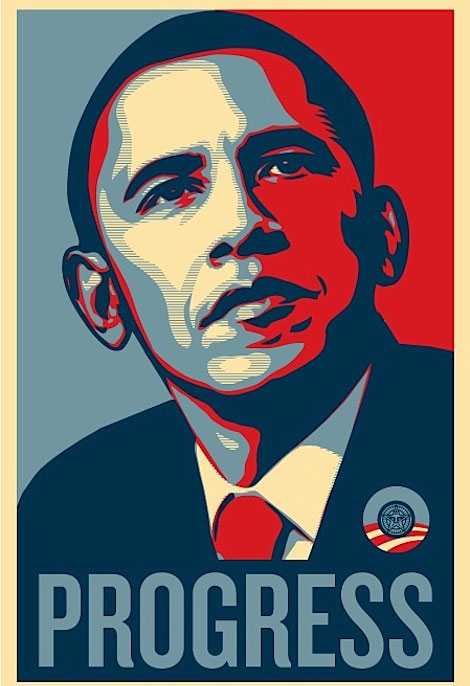
Shepard Fairey, the street artist behind the now iconic portrait of President Obama seen above, was arrested last night in Boston. He was accosted by police as he was about to enter an event at the Institute of Contemporary Art. Fairey was set to act as DJ for the night, a celebration of his new exhibit Supply and Demand.
The arrest was made on warrants recently issued for Fairey based on graffiti he created in Boston "early in his career," says the AP.
Was it really necessary to rain on the guy's parade right before his exhibit's opening night celebrations, tickets for which went for up to $500 on Craigslist? It sounds like Fairey would have had his hands full spinning music at the event - doubtful he would have tagged any more buildings. Maybe the police should have waited until the end of the night.
But, in general, things seem to be going pretty well for Fairey. If vindication from Obama during the campaign wasn't enough, the now-famous portrait was recently added to the collection of the National Portrait Gallery in Washington, D.C.
Fairey recently appeared on The Charlie Rose Show to discuss his personal history, involvement with the Obama campaign, and new-found fame.
Friday, February 6, 2009
Weather, Global Warming, and What We're Doing
Weather started cold and got colder this week in Amherst, with flurries on Tuesday and strong, biting winds on Thursday. The frigid temperature seemed to be the talk of the town this week, and many Amherst natives I spoke with agreed that this winter has seemed particularly miserable. But much more extreme weather is in effect elsewhere in the world.
Continued heavy snowfall has continued across Britain and more is apparently on its way. Flights are being canceled and drivers stranded as Britons face the "coldest snap for 20 years."
Heavy rain, snow, and even several tornadoes were reported over the weekend in Spain. Typically Spanish reports on overall trends: "Climate change is being blamed for the colder winter and hotter summer being seen in Spain, with this winter in already 1.5 degrees colder than average and with a Spring and Summer 2.1 degrees hotter."
While Europe's hoping for and end to the precipitation, portions of the U.S. are in desperate need of rain. Texas, California, and several Southeastern states are facing extreme to exceptional droughts.
It's becoming clearer and clearer that climate change is real and here to stay. Global warming is irreversible, suggests a new study in the Proceedings of the National Academy of Sciences. Al Gore visited the Senate at the end of last month to address the environment and what he thinks the government can do to help. Gore stressed reduction of American emissions, pointing out that many developing foreign countries already have far stricter emissions restrictions that the U.S.
So what are we doing about it? President Obama, in his second week in the White House, began tackling energy issues, claiming new fuel-efficiency requirements will be in place by 2011, ordering the EPA to consider tougher emissions standards for California and other states, and firmly declaring an reduction of dependence of foreign oil. While much of this is still talk, one hopes action isn't far behind.
The stimulus package that's currently under debate also includes a $100 billion package of "green" initiatives, covering conservation programs that would update federal buildings and homes to be more energy efficient, expansion of public transportation systems, and grants for renewable energy research. This is CNN's breakdown of the package:

Here's hoping this much-needed initiatives aren't ruled out as "pork."
Continued heavy snowfall has continued across Britain and more is apparently on its way. Flights are being canceled and drivers stranded as Britons face the "coldest snap for 20 years."
Heavy rain, snow, and even several tornadoes were reported over the weekend in Spain. Typically Spanish reports on overall trends: "Climate change is being blamed for the colder winter and hotter summer being seen in Spain, with this winter in already 1.5 degrees colder than average and with a Spring and Summer 2.1 degrees hotter."
While Europe's hoping for and end to the precipitation, portions of the U.S. are in desperate need of rain. Texas, California, and several Southeastern states are facing extreme to exceptional droughts.
It's becoming clearer and clearer that climate change is real and here to stay. Global warming is irreversible, suggests a new study in the Proceedings of the National Academy of Sciences. Al Gore visited the Senate at the end of last month to address the environment and what he thinks the government can do to help. Gore stressed reduction of American emissions, pointing out that many developing foreign countries already have far stricter emissions restrictions that the U.S.
So what are we doing about it? President Obama, in his second week in the White House, began tackling energy issues, claiming new fuel-efficiency requirements will be in place by 2011, ordering the EPA to consider tougher emissions standards for California and other states, and firmly declaring an reduction of dependence of foreign oil. While much of this is still talk, one hopes action isn't far behind.
The stimulus package that's currently under debate also includes a $100 billion package of "green" initiatives, covering conservation programs that would update federal buildings and homes to be more energy efficient, expansion of public transportation systems, and grants for renewable energy research. This is CNN's breakdown of the package:

Here's hoping this much-needed initiatives aren't ruled out as "pork."
Thursday, February 5, 2009
This Year's Grammys
In case you missed it, Katie Couric sat down last night with four musicians as part of the CBS "All Access" Grammy coverage. Of the four chosen artists, Lil Wayne was perhaps the most obvious pick. Not only was Tha Carter III 2008's best-selling album, moving nearly 3 million copies off the shelves, but it's one of the flat-out strangest albums to break the mainstream in years. Lil Wayne's claims of Martian origin don't seem so out there after hearing his oddly appealing garbage disposal of a voice and streams of non sequitur rhymes. Surely an interview with Couric, such a mainstay of normative American culture, might pique viewers' interests. Add to this his eight Grammy nominations, more than any other artist received this year, and his interview made sense.
Katy Perry, too, wasn't entirely surprising. Though she's up for only one nomination, Best Female Pop Vocal Performance, Perry's "I Kissed A Girl" spent seven weeks as America's #1 single. Relevant? Sure.
But Justin Timberlake? The man's only slightly in the running this year for his collaboration with Madonna on her lackluster single "Four Minutes." He's made no new music of his own since 2006's FutureSex / LoveSounds. And interviewee number four, Taylor Swift? She's got zero nominations, as her most recent album was released too recently to be counted.
This is "All Access" coverage? Instead of Justin Timberlake, who many viewers are surely familiar with already, how about Adele, a virtually unknown songstress who's up for four nominations including Best New Artist? Or, instead of Swift, who, again, is up for zero Grammys, how about Coldplay, who are up for seven?
Furthermore, do viewers even care about Grammy coverage when ratings have been so dismal in recent years? Unless, of course, this was merely a ploy for CBS, who also happens to be broadcasting the award ceremony, to drum up a few more viewers this year.
As for the interviews themselves, substance was sorely lacking. The most interesting thing we learned about Lil Wayne was already revealed in the show's promo clip - that he was born Dwayne Jr. but dropped the "D" (and the Jr.) since Dwayne Sr. was a deadbeat dad. When asked about being a role model, he had this to say: "Never in my life would I ever set out to be an example for people on how to live their lives. If you need an example for how to live, then you just shouldn’t have been born." Is he simply shrugging responsibility or is he presenting a potentially philosophical pondering? It only shows there's always two ways to take Weezy's output (like accepting Tha Carter III as a work of (flawed) genius, and rejecting his new "rock" single as the tepid Kid Rock wannabe it is).
As for Perry, the fact that she previosuly tried (and failed) to make it as Christian pop star may be news to some. That she's now the "bad girl" of the pop scene seems a surprising change for someone who still has the word "Jesus" tattooed on her wrist. Can you pull a 180 like that and maintain credibility? Does it matter to someone profiting off thinly-veiled lesbian sex? Her only hit before "I Kissed A Girl" was the bluntly-titled and potentially offensive "Ur So Gay," a criticism of a maybe homosexual boyfriend. As Couric put it, "But it wasn't an indictment against gay people or homosexuality?" Perry's answer: "Not at all." Well, that answers that, then! Continue to earn bucks by kissing girls in music videos.
Timberlake discussed acting, advertising, and golfing. Swift talked about her break-up with Joe Jonas and watching CSI.
Overall, not a thrilling night of television.
With any luck, the actual Grammys will prove more interesting. This year's performers include M.I.A., Radiohead, Stevie Wonder, Jamie Foxx, U2, and more. In a special performance, T.I. will perform with Jay-Z, Kanye West, and Lil Wayne, a big blowout before he receives his jail sentence at a March 29 court date.
The ceremony airs this Sunday at 8 on CBS.
Katy Perry, too, wasn't entirely surprising. Though she's up for only one nomination, Best Female Pop Vocal Performance, Perry's "I Kissed A Girl" spent seven weeks as America's #1 single. Relevant? Sure.
But Justin Timberlake? The man's only slightly in the running this year for his collaboration with Madonna on her lackluster single "Four Minutes." He's made no new music of his own since 2006's FutureSex / LoveSounds. And interviewee number four, Taylor Swift? She's got zero nominations, as her most recent album was released too recently to be counted.
This is "All Access" coverage? Instead of Justin Timberlake, who many viewers are surely familiar with already, how about Adele, a virtually unknown songstress who's up for four nominations including Best New Artist? Or, instead of Swift, who, again, is up for zero Grammys, how about Coldplay, who are up for seven?
Furthermore, do viewers even care about Grammy coverage when ratings have been so dismal in recent years? Unless, of course, this was merely a ploy for CBS, who also happens to be broadcasting the award ceremony, to drum up a few more viewers this year.
As for the interviews themselves, substance was sorely lacking. The most interesting thing we learned about Lil Wayne was already revealed in the show's promo clip - that he was born Dwayne Jr. but dropped the "D" (and the Jr.) since Dwayne Sr. was a deadbeat dad. When asked about being a role model, he had this to say: "Never in my life would I ever set out to be an example for people on how to live their lives. If you need an example for how to live, then you just shouldn’t have been born." Is he simply shrugging responsibility or is he presenting a potentially philosophical pondering? It only shows there's always two ways to take Weezy's output (like accepting Tha Carter III as a work of (flawed) genius, and rejecting his new "rock" single as the tepid Kid Rock wannabe it is).
As for Perry, the fact that she previosuly tried (and failed) to make it as Christian pop star may be news to some. That she's now the "bad girl" of the pop scene seems a surprising change for someone who still has the word "Jesus" tattooed on her wrist. Can you pull a 180 like that and maintain credibility? Does it matter to someone profiting off thinly-veiled lesbian sex? Her only hit before "I Kissed A Girl" was the bluntly-titled and potentially offensive "Ur So Gay," a criticism of a maybe homosexual boyfriend. As Couric put it, "But it wasn't an indictment against gay people or homosexuality?" Perry's answer: "Not at all." Well, that answers that, then! Continue to earn bucks by kissing girls in music videos.
Timberlake discussed acting, advertising, and golfing. Swift talked about her break-up with Joe Jonas and watching CSI.
Overall, not a thrilling night of television.
With any luck, the actual Grammys will prove more interesting. This year's performers include M.I.A., Radiohead, Stevie Wonder, Jamie Foxx, U2, and more. In a special performance, T.I. will perform with Jay-Z, Kanye West, and Lil Wayne, a big blowout before he receives his jail sentence at a March 29 court date.
The ceremony airs this Sunday at 8 on CBS.
Friday, January 30, 2009
Assignment: News Blog Review
"Your first assignment is to read an established news blog for at least three days. You will then post a review of this blog on your own personal class blog before midnight on Saturday, January 31."
The New Yorker News Desk is a blog collectively updated by various New Yorker staff persons. Over a three-day period (Tuesday, January 27 - Thursday, January 29), the main writers seemed to be Avi Zenilman (8 posts) and Amy Davidson (4 posts), with Elizabeth Kolbert and Michael Schulman each contributing one post.
At the start of each day, a writer (usually Zenilman) posts a summary of new news stories, labeled under the Skimming tag. These posts bring no new information to the table. Rather, they act as a summary of important events from the past day, linking the reader to other news websites or blogs (New York Times, New York Post, Politico, etc.). Oftentimes, the writer will provide links to several pieces that hold relevancy to the same topic.
For instance, on the morning of the 29th, Zenilman posted a link to this story reporting a possible end to mail delivery on Saturday, then to this opinion piece about shortening the work week. These two pieces are entirely relevant to each other, but they would not likely be read by an internet user without the guidance of such a post. As such, in these Skimming posts, even though the writer isn't reporting anything new, he or she is pointing out potentially new connections between multiple stories. Additionally, these succinct daily summaries of the news may be useful to someone without time to seek out the news from its original sources.
Posts labeled with Close Read also consist of news summary, but tend to focus less on important current events and more on soft news or, at least, less pressing hard news. The Close Read posted on January 27, for instance, discusses topics ranging from non-Guantanamo US-run foreign prisons to this year's Coca-Cola Super Bowl advertisement.
While much of the blog consists of news summary, the writers do bring some new material to the table. On January 29, Zenilman created a post in which she discusses Larissa MacFarquhar's article about Caroline Kennedy that appeared in the February 2 issue of The New Yorker magazine. The post acts somewhat as a follow-up to the article, as Zenilman posts a clip from the documentary Taking on the Kennedys (which MacFarquhar had referenced) before presenting a short question-and-answer with MacFarquhar.
The blog's appearance conforms to that of The New Yorker's website, which itself mimics the magazine. The links on the left-hand column are topped with category names written in the iconic Irvin typeface, while all text is a classic black on a white background. The blog's understated style maintains a classy, sophisticated cool, just as the parent publication does.
(It would appear that this blog is relatively new. When one clicks on archive, the oldest viewable post is from Monday, January 26. While I've been reading various other New Yorker blogs for quite some time, I only looked for and began reading the News Desk on, what do you know, Monday, January 26. Coincidence? I've emailed The New Yorker to find out.)
The New Yorker News Desk is a blog collectively updated by various New Yorker staff persons. Over a three-day period (Tuesday, January 27 - Thursday, January 29), the main writers seemed to be Avi Zenilman (8 posts) and Amy Davidson (4 posts), with Elizabeth Kolbert and Michael Schulman each contributing one post.
At the start of each day, a writer (usually Zenilman) posts a summary of new news stories, labeled under the Skimming tag. These posts bring no new information to the table. Rather, they act as a summary of important events from the past day, linking the reader to other news websites or blogs (New York Times, New York Post, Politico, etc.). Oftentimes, the writer will provide links to several pieces that hold relevancy to the same topic.
For instance, on the morning of the 29th, Zenilman posted a link to this story reporting a possible end to mail delivery on Saturday, then to this opinion piece about shortening the work week. These two pieces are entirely relevant to each other, but they would not likely be read by an internet user without the guidance of such a post. As such, in these Skimming posts, even though the writer isn't reporting anything new, he or she is pointing out potentially new connections between multiple stories. Additionally, these succinct daily summaries of the news may be useful to someone without time to seek out the news from its original sources.
Posts labeled with Close Read also consist of news summary, but tend to focus less on important current events and more on soft news or, at least, less pressing hard news. The Close Read posted on January 27, for instance, discusses topics ranging from non-Guantanamo US-run foreign prisons to this year's Coca-Cola Super Bowl advertisement.
While much of the blog consists of news summary, the writers do bring some new material to the table. On January 29, Zenilman created a post in which she discusses Larissa MacFarquhar's article about Caroline Kennedy that appeared in the February 2 issue of The New Yorker magazine. The post acts somewhat as a follow-up to the article, as Zenilman posts a clip from the documentary Taking on the Kennedys (which MacFarquhar had referenced) before presenting a short question-and-answer with MacFarquhar.
The blog's appearance conforms to that of The New Yorker's website, which itself mimics the magazine. The links on the left-hand column are topped with category names written in the iconic Irvin typeface, while all text is a classic black on a white background. The blog's understated style maintains a classy, sophisticated cool, just as the parent publication does.
(It would appear that this blog is relatively new. When one clicks on archive, the oldest viewable post is from Monday, January 26. While I've been reading various other New Yorker blogs for quite some time, I only looked for and began reading the News Desk on, what do you know, Monday, January 26. Coincidence? I've emailed The New Yorker to find out.)
Subscribe to:
Posts (Atom)
